Sriwijaya Air Review Sentiment Analysis
An end-to-end Indonesian NLP pipeline classifying 1,756 Google Play reviews of the Sriwijaya Air Mobile app into three sentiment classes, then turning negative reviews into a product complaint taxonomy.
Visual Exhibit
System Blueprint & Verification.
Algorithmic mechanism and measured empirical evidence from the shipped system.
1,756 passenger reviews classified with aspect-level complaint tags
Engineering Takeaways
Key Pillars & Findings.
1,756 Google Play reviews, weak-labeled from star ratings
Logistic Regression vs Linear SVM vs Naive Bayes on the same split
Negative-review aspect taxonomy plus held-out error analysis
Technical Specification & Methodology Notes Expand paper spec
Context
This is an NLP coursework project at ITS: sentiment analysis on Google Play reviews of the Sriwijaya Air Mobile app. I scraped 1,799 reviews with google_play_scraper, kept 1,756 after cleaning, and built the full pipeline end to end: preprocessing, feature engineering, model comparison, evaluation, error analysis, and a Streamlit inference demo.
Labels are derived from star ratings: 1 to 2 stars is negative, 3 is neutral, 4 to 5 is positive. That makes them weak labels, a rating is a useful proxy for sentiment but not a human annotation, and the whole evaluation has to be read with that in mind.
Problem
Airline app reviews are mixed-language (Indonesian with English fragments), short, and heavily imbalanced: 806 negative, 863 positive, and only 87 neutral reviews. The interesting questions were less “can a classifier fit this” and more operational: which model holds up on a held-out split, where exactly does it fail, and can the output be turned into something a product team could actually use.
Approach
- Preprocessing for mixed Indonesian and English text: lowercasing, tokenization, bilingual stopword removal, English lemmatization, Indonesian and English stemming, contraction expansion, and word normalization.
- Features: TF-IDF over unigrams, bigrams, and trigrams, plus simple numeric features (word count, character count, average word length).
- Models: Logistic Regression, Linear SVM, and Naive Bayes compared on the same stratified 80:20 split, with random oversampling applied to the training split only to help the small neutral class.
- Evaluation on the held-out test set with accuracy, macro F1, weighted F1, per-class F1, and a confusion matrix.
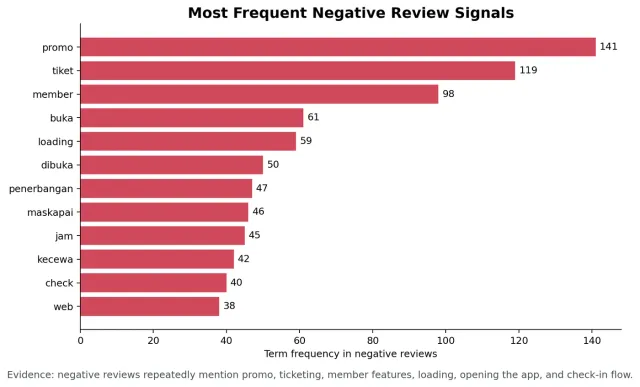
- Beyond classification: a rule-based keyword taxonomy over negative reviews (app performance, check-in, ticketing, promo, login, payment, membership, customer service) to rank what users actually complain about.
Evidence
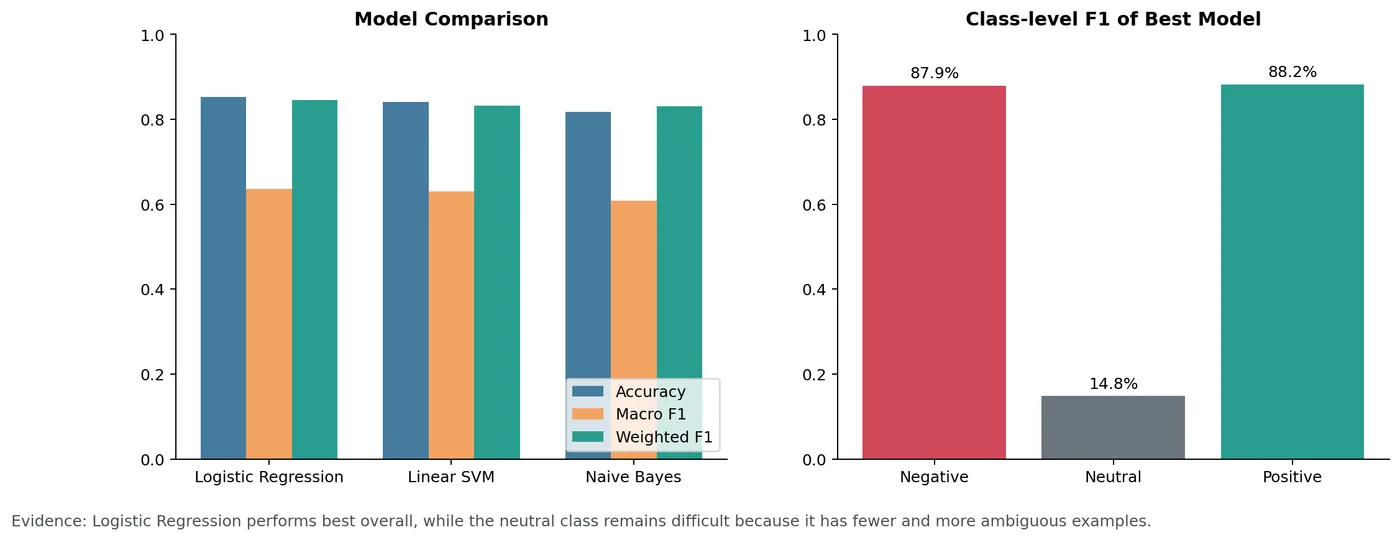
Logistic Regression won on macro F1; per-class F1 exposes the weak neutral class honestly.
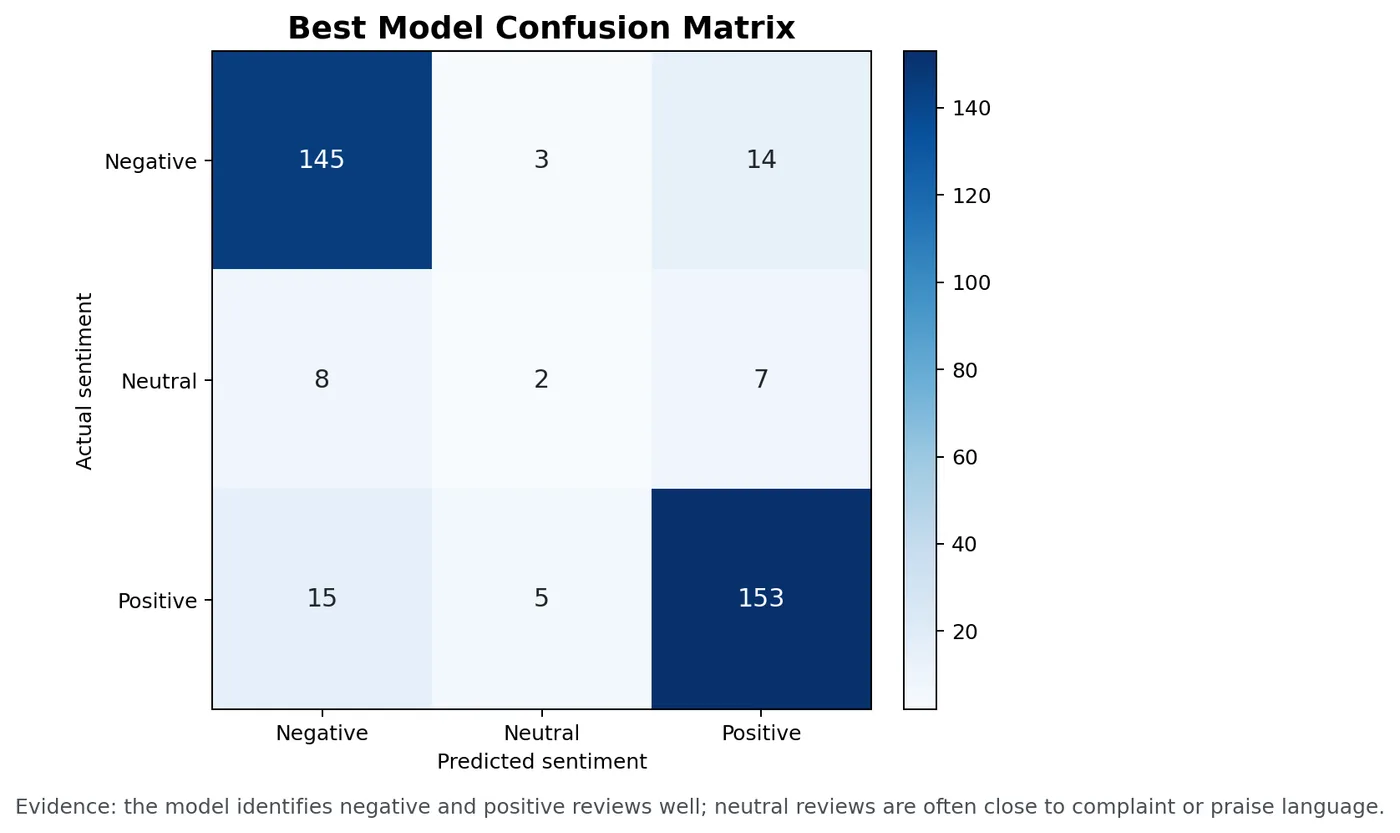
Held-out confusion matrix: negative and positive separate cleanly, neutral gets absorbed by both.
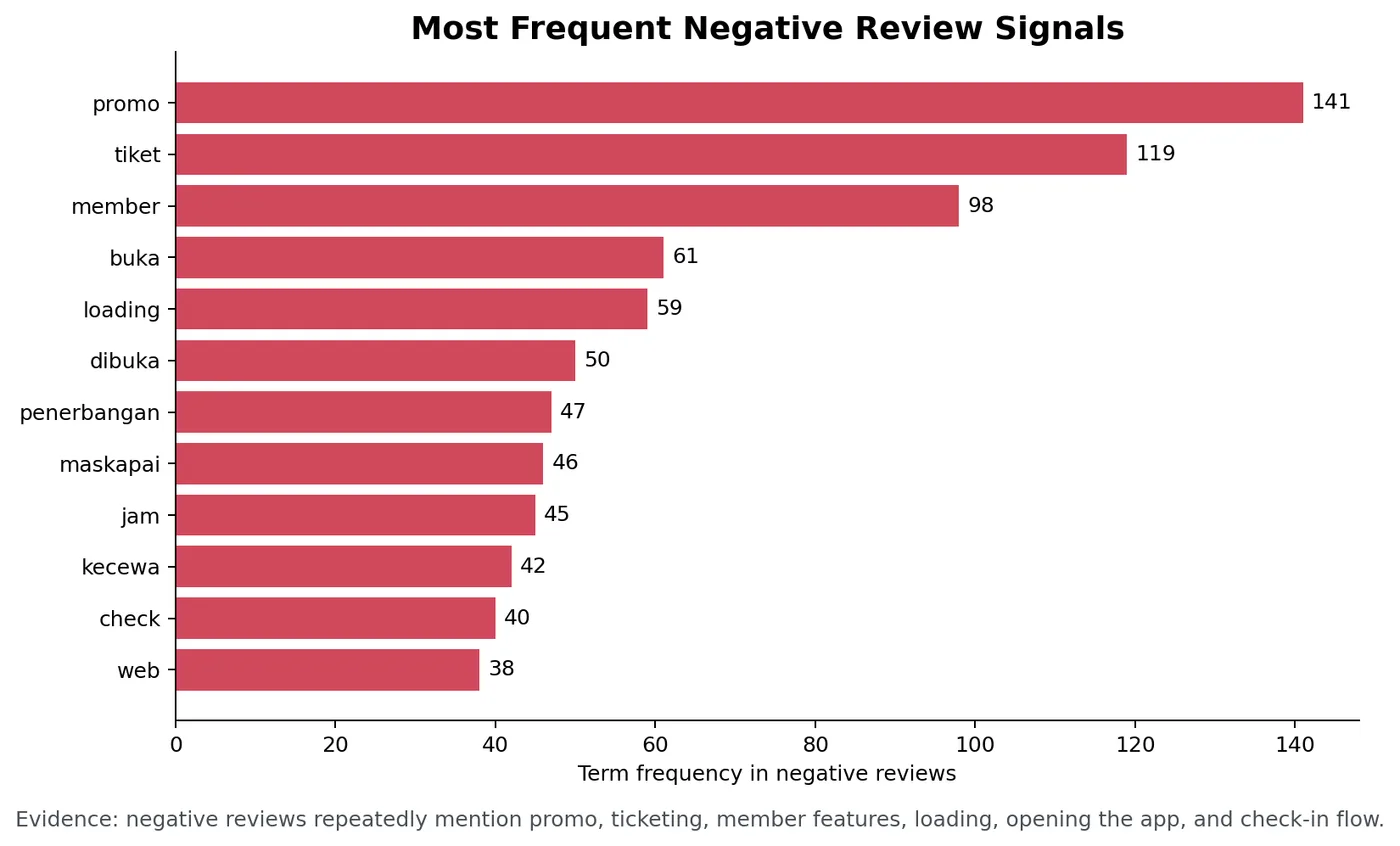
Negative reviews cluster around promos, ticketing, membership, and the app failing to open.
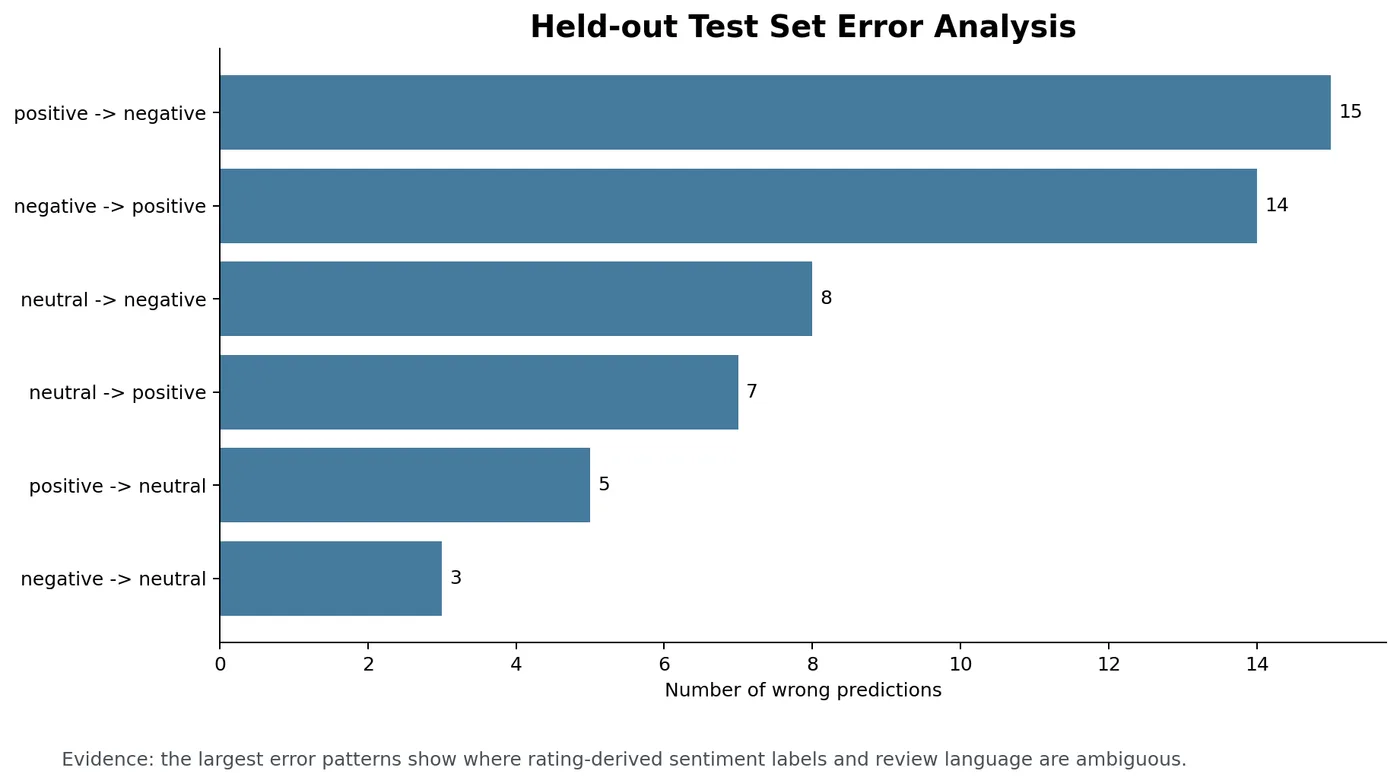
Error analysis on the held-out split: most mistakes involve the ambiguous neutral class.
Key Decisions
Oversampling only the training split. Balancing the whole dataset before splitting would leak duplicated neutral reviews into the test set and inflate every score; keeping the test set untouched kept the evaluation honest.
Selecting the best model by macro F1 instead of accuracy. With 87 neutral rows against 1,669 others, accuracy is nearly blind to the minority class; macro F1 is the metric that actually punishes ignoring it.
Treating the labels as weak labels explicitly. Rating 3 reviews mix complaints, suggestions, and mild praise, so neutral F1 of 0.15 is reported as a data problem to solve with manual annotation, not hidden behind the strong 0.88 negative and positive F1 scores.
Result
Logistic Regression was the best of the three models with 0.852 accuracy, 0.636 macro F1, and 0.845 weighted F1 on the held-out test set, against 0.841 accuracy for Linear SVM and 0.818 for Naive Bayes.
The aspect analysis turned the model output into product insight: negative reviews concentrate on promos, ticketing and booking, membership features, and the app failing to open or load. The pipeline ships with a model card documenting intended use and limitations, and a Streamlit demo for classifying new review text.
What I’d Improve
Manually annotate 100 to 150 reviews to measure how far rating-based labels drift from human judgment, add cross-validation with hyperparameter tuning, and test IndoBERT or another multilingual transformer once a stronger labeling baseline exists. The neutral class needs data work before it needs a bigger model.