Fraud Detection ML Pipeline (Undergraduate Thesis)
An Autoencoder-based latent-space oversampling pipeline for extreme class imbalance, paired with Bayesian-tuned LightGBM, on the IEEE-CIS fraud dataset.
Visual Exhibit
System Blueprint & Verification.
Algorithmic mechanism and measured empirical evidence from the shipped system.
74.7% recall at 89% precision · 3,087 fraud caught
Engineering Takeaways
Key Pillars & Findings.
0.855 test PR-AUC vs. 0.850 tuned baseline and 0.850 tuned SMOTE-NC
Autoencoder as a latent-space oversampler, not a feature extractor (that variant was tested and rejected)
Bayesian Optimization (Optuna/TPE) beat random search by +0.004 validation PR-AUC at matched compute
Technical Specification & Methodology Notes Expand paper spec
Context
This is my undergraduate thesis at Institut Teknologi Sepuluh Nopember (ITS): fraud detection on the IEEE-CIS Fraud Detection dataset (Kaggle, Vesta Corporation), featuring 590,540 e-commerce transactions, 3.5% fraud (20,663 fraud vs. 569,877 legitimate). The proposed method combines an Autoencoder with LightGBM under Bayesian Optimization; the interesting part is that the Autoencoder’s role in that pipeline changed once I diagnosed why the original design wasn’t working.
Problem
At 3.5% fraud, a classifier optimized for accuracy is close to useless, because predicting “not fraud” every time already scores 96.5%. The real work is in the representation of the minority class, a fair evaluation protocol under stratified 60/20/20 splitting, and a tuning budget that can’t afford grid search.
Approach
- Diagnosed the original design first. The initial plan used the Autoencoder as a feature extractor: train it on legitimate transactions, append reconstruction error and/or latent codes as extra features for LightGBM. Across every variant I tried (global and grouped reconstruction error, 32-dim latent concatenation, and a score-level ensemble), none beat the plain LightGBM baseline (deltas −0.005 to −0.024 AP, all p≈1.0 under paired bootstrap); a score ensemble gave the AE zero weight. The root cause: the AE was reconstructing the same
V-block of engineered features LightGBM’s trees already split on, so it added noise, not signal. - Pivoted to latent-space oversampling. Instead of feeding the AE’s output to the classifier, I use it to synthesize fraud: train an undercomplete Autoencoder (128→64→64 bottleneck, MSE loss, Adam) on fraud-only training rows, embed those rows into latent space, run SMOTE-style k=5 interpolation between latent fraud points (Chawla et al., 2002, applied in
z-space rather than raw feature space, a tabular adaptation of DeepSMOTE/nDeepSMOTEc), then decode the interpolated points back into synthetic fraud rows appended only to the training split. - Locked the sensitivity parameters on validation, not by guesswork.
latent_dimand target synthetic fraud rate were chosen from a grid sweep (latent_dimof 8, 16, 32, or 64, crossed with a target rate of 10%, 15%, 20%, 30%, or 50%) scored by validation PR-AUC, locked atlatent_dim=64, rate=10%. - Controlled comparison. The AE-oversampled scenario is compared against a plain LightGBM baseline and a SMOTE-NC control at the same target fraud rate, on the same frequency-encoded + z-scored feature representation, so the win can’t be attributed to oversampling in general.
- Bayesian Optimization over LightGBM’s hyperparameters using Optuna with a TPE sampler, 10 trials over a 7-dimensional space (learning rate,
num_leaves,min_child_samples,subsample,colsample_bytree,reg_alpha,reg_lambda), objective = validation PR-AUC, on a 2000-tree LightGBM with 100-round early stopping.
Evidence
All four figures below are taken directly from the thesis paper (POMITS submission); axis labels and annotations are in Indonesian because that is the language of the original document.
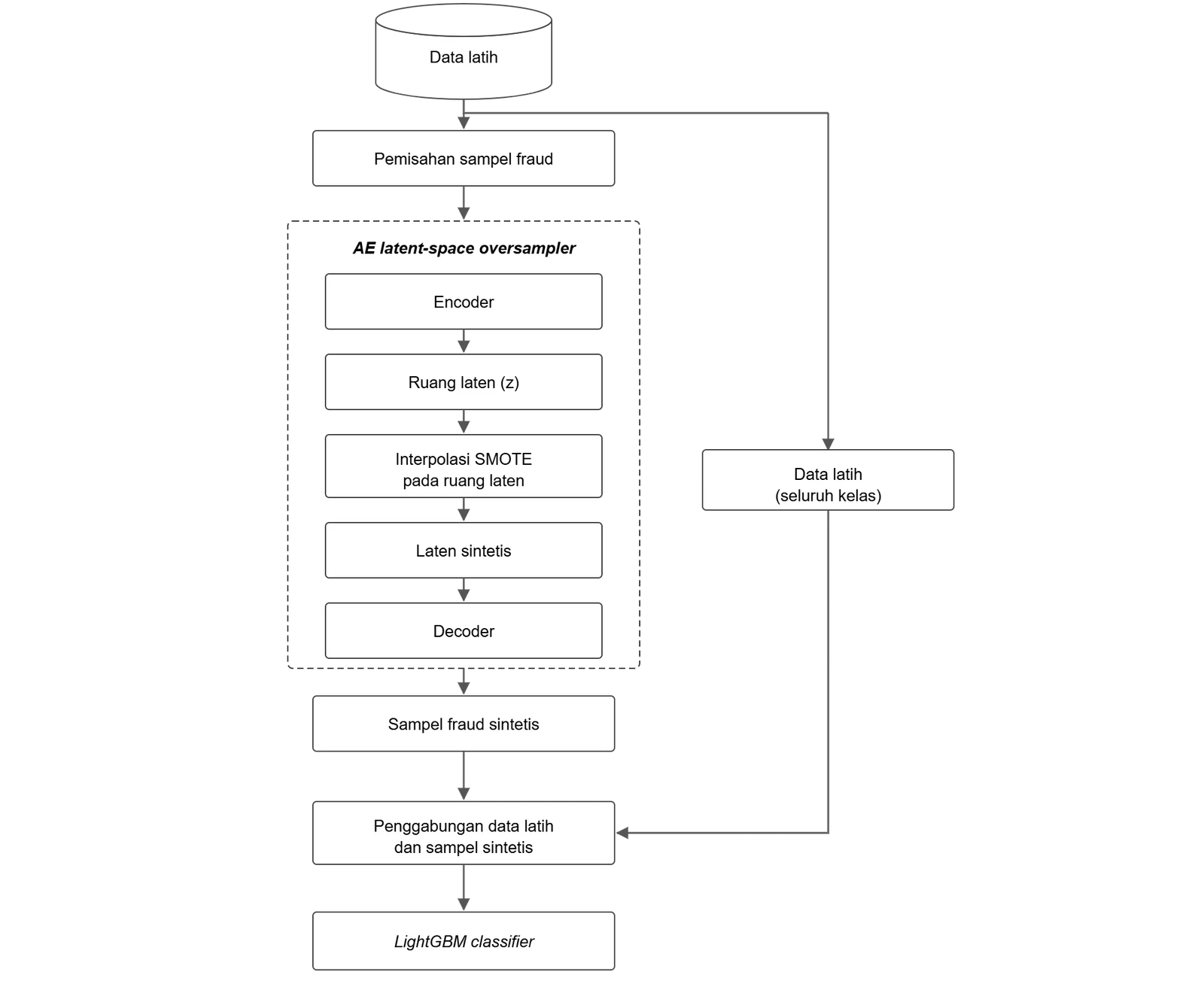
Pipeline diagram from the paper: AE-trained-on-fraud latent-space oversampling, synthetic fraud merged into training data, then LightGBM.
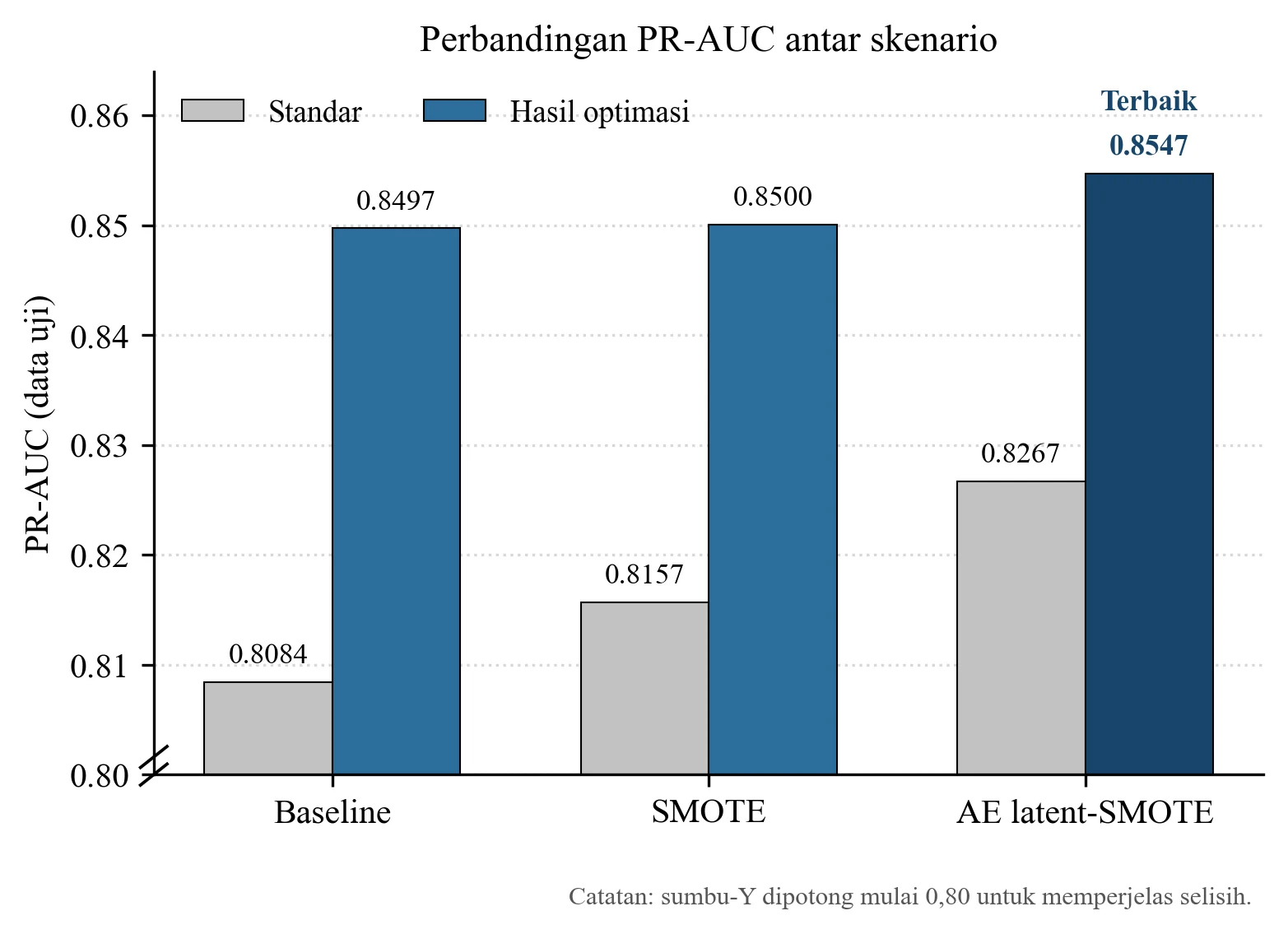
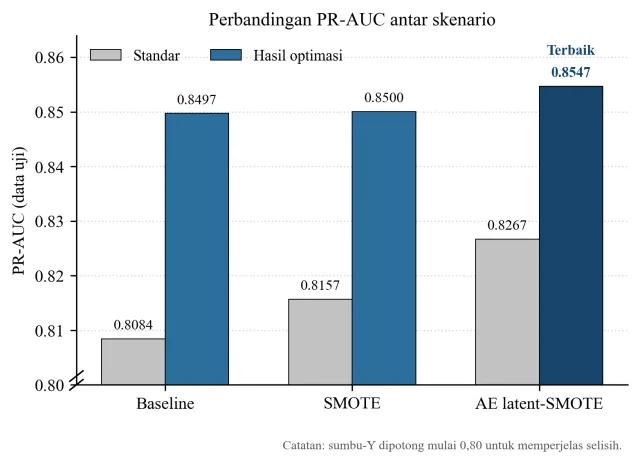
Test PR-AUC per scenario, untuned and tuned: AE latent-SMOTE leads in both regimes (0.8547 tuned vs. 0.8497 baseline and 0.8500 SMOTE).
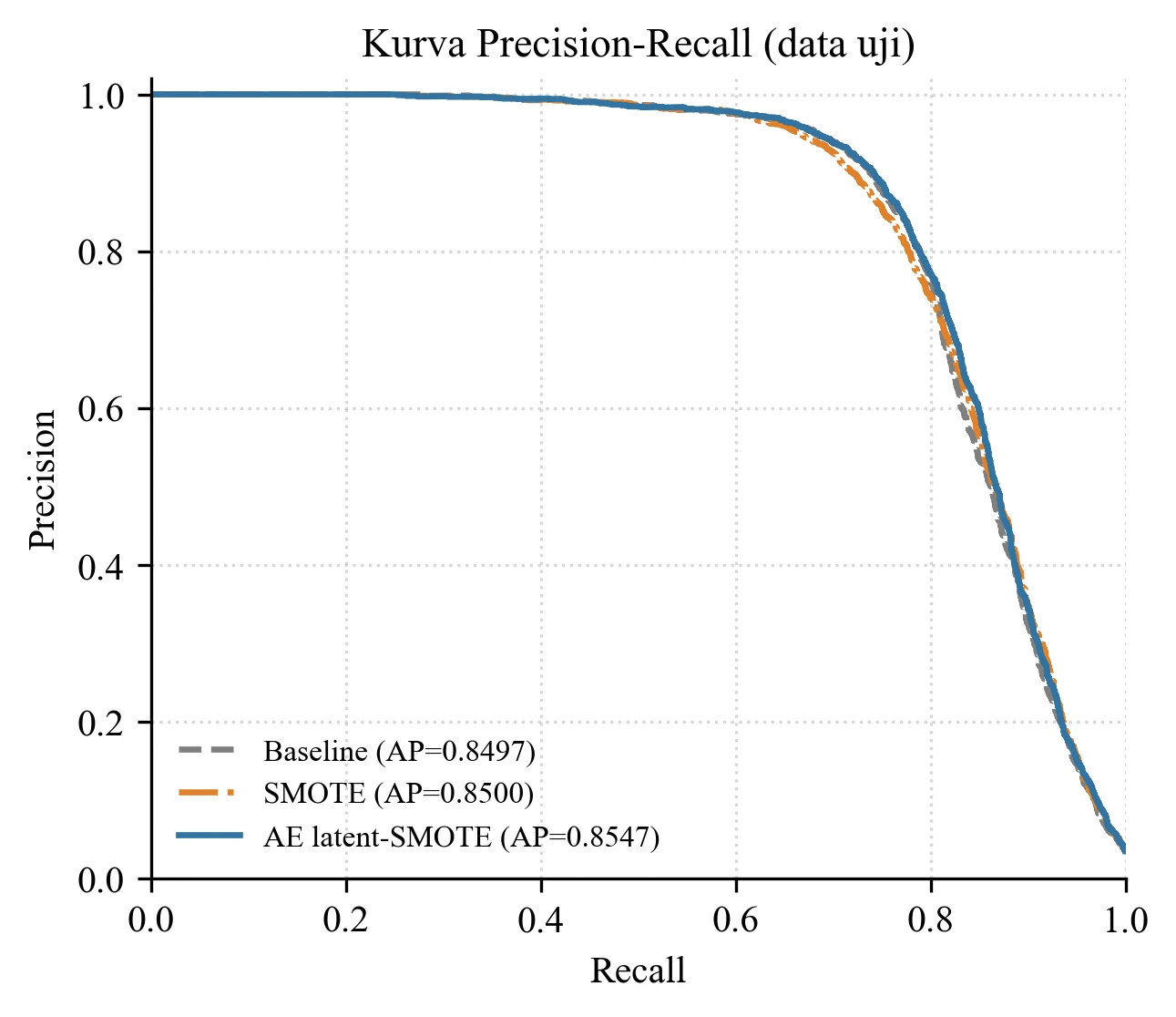
Test-set Precision-Recall curves for the three scenarios; the AE latent-SMOTE curve dominates in the high-precision region.
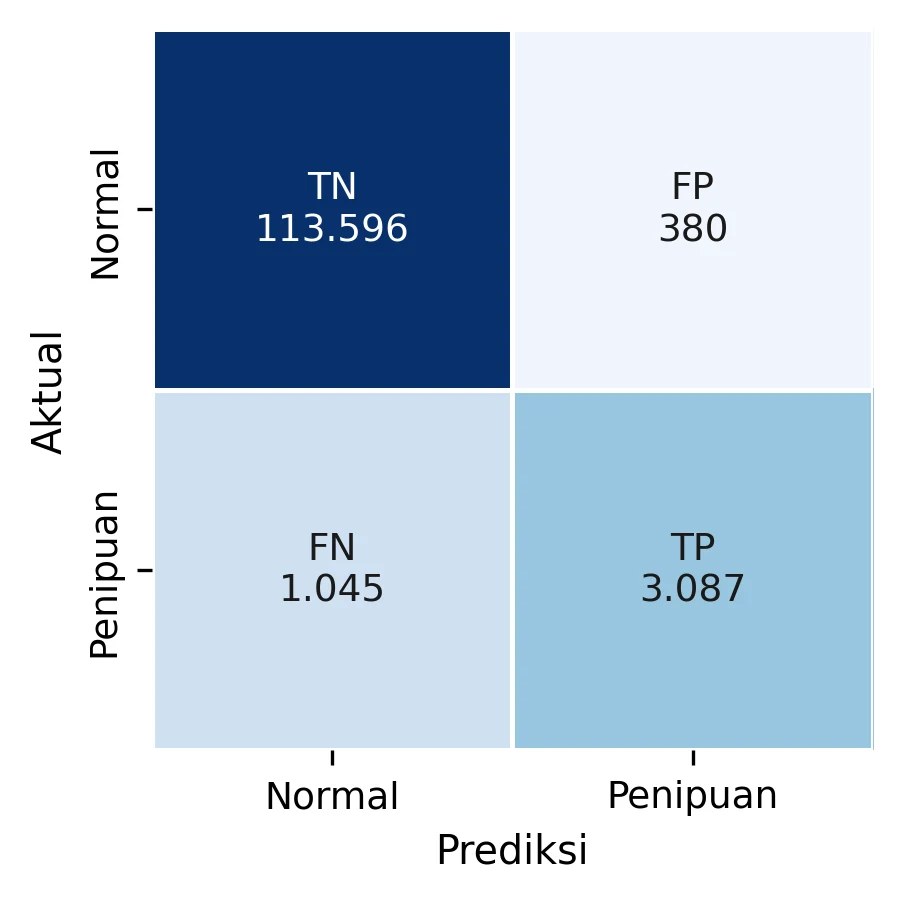
Operating-point confusion matrix from the paper: 3,087 fraud caught, 1,045 missed, 380 false alarms, yielding 74.71% recall at 89.04% precision.
Key Decisions
Why latent-space oversampling instead of feature extraction. This wasn’t the original plan; it is the result of a diagnosis. Reconstruction-error and latent-code features never beat the baseline because the AE was redundant with what LightGBM’s trees already extracted from the same engineered features. Rather than force a feature-extractor narrative to fit disappointing numbers, I re-read where the literature (DeepSMOTE, nDeepSMOTEc) uses autoencoders for imbalanced tabular data as a generator rather than an encoder for the classifier, and that reframing is what actually worked.
Why SMOTE-NC as an explicit control, not just a second baseline. Any oversampling method reduces the effect of class imbalance; the question that matters is whether the autoencoder specifically is doing something SMOTE-NC alone can’t. Matching the target fraud rate between the two isolates that one variable, so the AP gap between them is attributable to the AE’s on-manifold interpolation, not to “more fraud examples” in general.
Why Bayesian Optimization over random or grid search. Grid search doesn’t scale past a couple of hyperparameters at this dataset size, and I wanted evidence rather than an assumption for choosing Optuna’s TPE sampler over plain random search, so I re-ran the same 7-D space, same 10-trial budget, with random search as a control: TPE reached 0.8589 validation PR-AUC vs. 0.8548 for random search, in essentially the same wall-clock time.
Result
| Scenario (test PR-AUC) | Untuned | Bayesian-tuned |
|---|---|---|
| Plain LightGBM | 0.8084 | 0.8497 |
| SMOTE-NC control | 0.8157 | 0.8500 |
| AE latent-SMOTE | 0.8267 | 0.8547 |
The tuned AE latent-oversampling pipeline reaches 0.8547 test PR-AUC (Average Precision), vs. 0.8497 for a tuned plain-LightGBM baseline and 0.8500 for tuned SMOTE-NC. Untuned, the gap is wider (0.8267 vs. 0.8084 baseline, +0.0183). At the validation-selected operating threshold, the AE model recalls 74.71% of fraud at 89.04% precision, catching 41 more fraud transactions than the baseline (3,087 vs. 3,046 true positives), at the cost of 55 more false positives (380 vs. 325) out of 113,976 legitimate test transactions.
What I’d Improve
- Run paired-bootstrap significance testing on this exact final checkpoint. An earlier iteration of the same method had a bootstrap-tested AE-vs-baseline gap (p<0.001), but I didn’t re-run that test on the final submitted numbers, and I’d rather say so than imply a stats test that wasn’t done.
- Add a temporal/chronological validation split to check for concept drift. Under a naive chronological split the baseline PR-AUC collapses to ~0.5, which I currently attribute to entity leakage across train/test under the stratified split rather than a real drift signal, but that’s a limitation worth closing out properly.
- Extend the latent oversampler with the clustering-enhanced variant from nDeepSMOTEc (Fan et al., 2025) rather than plain k=5 interpolation.